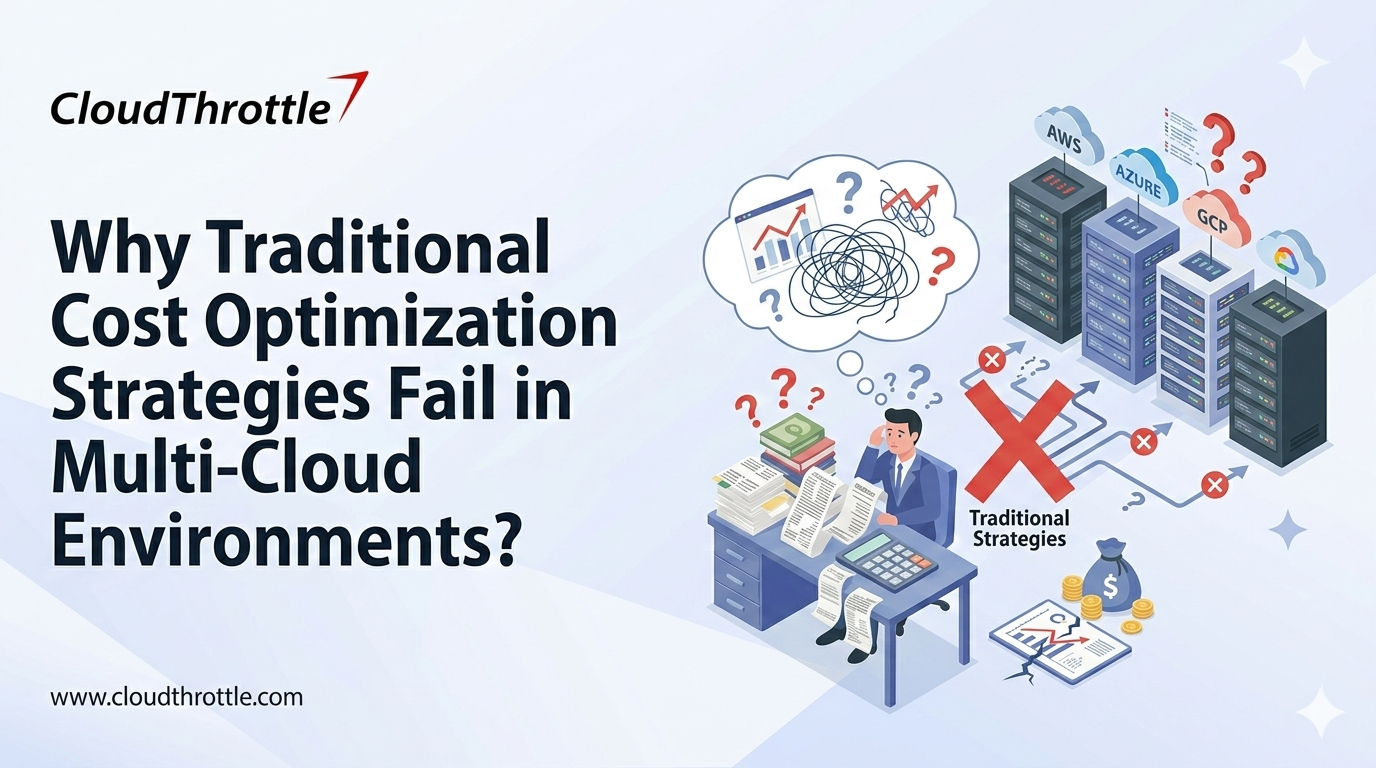
Cloud adoption once meant selecting a single provider and applying straightforward cost controls. Multi-cloud has changed that model. Organizations now distribute workloads across AWS, Azure, and Google Cloud to meet regulatory needs and leverage specialized services. However, many organizations still operate primarily within a dominant cloud provider while exploring multi-cloud strategies.
Many teams extend legacy methods, such as manual tagging, reviews, or periodic billing analysis. These approaches struggle in environments with differing pricing models and shared ownership across platforms. Modern cloud computing cost optimization strategies must reflect distributed architecture, normalized pricing interpretation, and real-time consumption intelligence. Understanding why traditional strategies fail is the first step toward restoring cost discipline. Let us see where they fall short and how organizations can build a stronger multi-cloud cost framework.
The Shift From Single-Cloud to Multi-Cloud Reality
Modern cloud architecture has moved from consolidation to distribution. Application portfolios now span multiple providers because technical requirements vary across workloads and performance objectives. This shift has architectural advantages, yet it introduces financial and operational variables that traditional cloud infrastructure and cost optimization strategies were never designed to interpret.
The following are the structural forces driving this transition:
- Organizations Adopt Multi-Cloud for Flexibility and Risk Distribution
Companies match workloads to the strengths of each supplier, such as analytics engines or the number of services available in a certain area. Regulatory requirements frequently necessitate the geographic segregation of sensitive datasets, resulting in intentional distribution across countries.
Vendor independence lessens the risk of price fluctuations or service deprecations that happen on their own. These choices are based on robustness and performance engineering, but they break up consumption patterns across many billing domains.
- Financial Models Did Not Evolve at the Same Pace
Procurement workflows and cost governance processes were originally calibrated to a single provider relationship. Multi-cloud adds various billing systems and telemetry pipelines. Financial teams often try to combine various datasets manually, which makes reconciliation slower and analysis less accurate. Legacy cloud computing cost optimization strategies fail to provide normalized visibility across providers in such environments. The organization has a distributed infrastructure, but it still uses centralized financial assumptions to measure performance.
Where Traditional Cost Optimization Breaks Down?
Optimization methods begin to lose accuracy and relevance as architecture decentralizes and financial models remain static. Below are the primary areas where legacy cost strategies fail to operate effectively.
- Lack of Unified Cost Visibility
Each provider exposes billing data through different APIs, currency normalization rules, and service taxonomies. AWS may aggregate at the service level, while another provider itemizes usage by SKU or meter category.
Creating a consolidated dataset requires transformation pipelines and mapping logic before cost analysis can even begin. This delay prevents near real-time decision-making and weakens financial observability. Traditional cloud infrastructure cost optimization strategies were not designed to normalize multi-provider billing structures at this scale.
- Inconsistent Pricing Models Across Providers
Compute commitments and storage lifecycle pricing follow distinct mathematical models. Reserved capacity in one environment does not map directly to committed spend agreements in another. Engineering teams optimize within local pricing constructs, which prevents comparative evaluation of workload economics across platforms. Modern cloud computing cost optimization strategies must interpret and standardize these pricing variables before meaningful optimization can occur.
- Siloed Monitoring Tools Create Fragmented Insights
Provider-native observability stacks generate telemetry tied to their own infrastructure abstractions. Metrics such as CPU utilization, IOPS, or network throughput cannot be correlated without an external aggregation layer. Optimization signals, therefore, remain isolated and cannot inform cross-cloud resource strategy. The best cloud cost optimization strategies 2026 emphasize unified observability to bridge these operational silos.
- Manual Tagging and Allocation Become Unreliable at Scale
Chargeback models rely on consistent metadata applied during provisioning. Distributed DevOps teams introduce variance in tagging schemas, capitalization, and ownership fields. Even small inconsistencies compound across thousands of resources, degrading allocation accuracy and introducing financial ambiguity. This limitation becomes even more pronounced in cloud cost optimization strategies for small businesses, where governance resources are often limited.
- Static Budgeting Cannot Keep Up With Elastic Consumption
Elastic compute models scale automatically in response to demand signals generated by application telemetry. Traditional budgeting assumes predictable utilization baselines and gradual expansion. Financial forecasts, therefore, lag behind operational activity, leading to reactive adjustments rather than guided consumption control. Cloud cost optimization strategies 2026 require real-time telemetry and usage-informed forecasting to keep pace with elastic infrastructure.
The Hidden Cost Drivers Unique to Multi-Cloud
Once optimization visibility weakens, additional cost vectors begin to surface within the distributed environment.
Here are cost drivers that rarely appear in initial cloud migration models.
- Data Transfer and Inter-Cloud Movement
Applications exchange data across providers for redundancy, analytics aggregation, and API orchestration. Every outbound transfer introduces egress billing that compounds with volume and frequency. These charges often bypass traditional monitoring because they are classified as network operations rather than compute usage. Mature cloud computing cost optimization strategies account for inter-cloud traffic as a primary cost variable rather than a secondary metric.
- Duplicate Services Across Platforms
Operational parity requires replication of logging systems, security scanners, container registries, and CI/CD infrastructure in each cloud. This duplication increases licensing, storage, and maintenance overhead while also introducing configuration drift. Even well-designed cloud infrastructure cost optimization strategies fail to detect service redundancy across environments without coordinated governance.
- Overprovisioning Due to Visibility Gaps
Limited cross-platform telemetry encourages conservative provisioning strategies. Teams allocate excess capacity to guarantee performance thresholds because there is no consolidated utilization baseline to validate safe reduction. Idle infrastructure becomes embedded in steady-state cost. Cloud cost optimization strategies 2026 emphasize unified utilization intelligence to prevent systematic overprovisioning.
- Operational Complexity Adds Indirect Financial Overhead
Engineering resources must maintain identity federation, API compatibility layers, and configuration synchronization across heterogeneous environments. Labor devoted to maintaining interoperability represents a hidden operational expense tied directly to architectural dispersion. The best cloud cost optimization strategies 2026 evaluate both infrastructure spend and operational labor as part of total cloud economics.
Why Native Cloud Cost Tools Are Not Enough?
Organizations frequently attempt to regain control using built-in cost management tools, yet those tools inherit the same provider-centric limitations.
The following are the constraints that prevent native tooling from addressing multi-cloud economics.
- Provider Tools Optimize Within Their Own Ecosystem
Native analyzers evaluate rightsizing opportunities and idle resource detection only within their platform boundaries. They lack comparative analytics that assess whether a workload would perform more efficiently elsewhere. Optimization remains localized rather than portfolio-driven.
- Metrics Lack Business Context
Billing exports measure infrastructure units such as vCPU hours or storage transactions. Business leaders require cost attribution aligned to services, customers, or revenue streams. Without contextual mapping, financial analysis cannot influence strategic planning.
The Need for a FinOps-Led Multi-Cloud Strategy
Restoring cost discipline requires governance models that align financial intelligence with distributed engineering activity.
Below are foundational principles of a FinOps-led approach.
- Financial Accountability Must Align With Engineering Decisions
Infrastructure cost is a direct outcome of design parameters such as scaling thresholds, redundancy models, and regional placement. FinOps frameworks integrate finance teams into architectural review cycles so cost behavior is evaluated alongside performance characteristics. Effective cloud infrastructure and cost optimization strategies therefore embed financial review directly into engineering decision-making rather than treating cost as a downstream metric.
- Standardized Cost Taxonomy Creates Comparability
A normalized classification model translates provider-specific billing categories into a unified schema. Compute, storage, and network usage can then be evaluated consistently across environments, which supports accurate benchmarking and forecasting. Modern cloud computing and cost optimization strategies rely on standardized taxonomies to ensure meaningful cross-provider comparison.
- Real-Time Usage Intelligence Replaces Periodic Reviews
Streaming cost telemetry enables continuous analysis of consumption behavior. Teams detect anomalies, validate optimization measures, and adjust provisioning policies within operational timelines rather than waiting for monthly billing cycles. Advanced cloud cost optimization strategies 2026 prioritize real-time intelligence over retrospective reporting.
- Shared Cost Ownership Drives Behavioral Change
Cost optimization becomes sustainable when product teams, platform engineers, and finance stakeholders share responsibility for consumption outcomes. Visibility tied to team-level usage encourages design decisions that reflect both technical performance and financial impact. The best cloud cost optimization strategies 2026 emphasize shared accountability as a structural governance principle.
- Continuous Optimization Becomes Part of the Delivery Lifecycle
FinOps practices integrate cost evaluation into CI/CD workflows, architecture reviews, and deployment approvals. Every release is assessed for resource efficiency and usage patterns, which turns optimization into an operational habit rather than a periodic correction exercise. This approach strengthens long-term cloud cost optimization strategies for small businesses and large enterprises alike by embedding financial discipline into delivery processes.
Modern Approaches That Address Multi-Cloud Cost Challenges
With governance aligned to distributed architecture, optimization evolves into a continuous operational discipline.
Here are approaches that align technical execution with financial control.
- Centralized Cost Observability Platforms
Cross-cloud observability layers ingest billing APIs, utilization metrics, and configuration metadata into a single analytical framework. In practice, many organizations begin by centralizing visibility within their primary cloud provider before expanding to broader multi-cloud observability.
- Workload Placement Based on Economic Efficiency
Architecture teams evaluate workloads using performance-to-cost ratios, latency requirements, and transaction economics. Placement decisions become analytical rather than habitual. Mature cloud infrastructure cost optimization strategies incorporate economic modeling into workload placement to ensure that performance objectives align with financial efficiency across providers.
- Automation for Rightsizing and Lifecycle Management
Policy engines analyze utilization trends and dynamically adjust allocations through scheduled scaling and lifecycle enforcement. Resource consumption aligns continuously with demand characteristics. Contemporary cloud cost optimization strategies 2026 position automation as a core mechanism for sustaining efficiency in elastic environments.
- Policy-Driven Governance Instead of Manual Enforcement
Provisioning workflows embed financial guardrails that validate configurations before deployment. Governance becomes preventative, which reduces waste before it enters the environment. The best cloud cost optimization strategies 2026 shift from reactive audits to policy-driven controls that embed financial discipline directly into infrastructure workflows.
Traditional Optimization vs Multi-Cloud FinOps Approach
Disclaimer: For informational purposes only, based on publicly available information at the time of publication. Pricing, features, and capabilities may change; verify with vendors. No endorsement or warranties implied.
Conclusion
Multi-cloud adoption introduced architectural flexibility, yet it also exposed the limits of traditional cloud infrastructure and cost optimization strategies built for simpler, single-provider environments. Fragmented billing structures and distributed ownership require a shift from reactive cost control to integrated financial governance. Organizations that embrace modern cloud computing cost optimization strategies grounded in FinOps gain the ability to interpret consumption patterns across platforms, align infrastructure decisions with economic outcomes, and maintain cost discipline without sacrificing technical agility.
Organizations seeking clarity and control over multi-cloud spending need more than periodic cost reports. They need a strategy that connects architecture, operations, and financial governance into a unified model. CloudThrottle helps organizations build that foundation by implementing unified cost visibility, FinOps frameworks, and automation-driven optimization within AWS multi-account environments. As enterprises evolve toward distributed and multi-cloud models, establishing strong governance in the primary cloud provider is the first critical step. Connect with us to build a financially accountable and performance-aligned cloud operating model. +
Note: Information reflects publicly available sources at the time of publication and may change.