How do you maintain cost control when your AWS environment grows from a few accounts to dozens spread across teams, products, and regions? The challenge is not visibility alone. It is governance at scale, where decisions must stay fast while costs remain controlled.
Read this blog to understand how to build a multi-account cost control system that scales without slowing teams down.
What Is AWS Multi-Account Cost Control?
AWS multi-account cost control means managing cloud spend across multiple AWS accounts through a combination of billing visibility, governance policies, and operational controls within a structured system. Teams need clear visibility of total costs, defined ownership at the account or workload level, and the ability to act before overspending becomes a pattern. A single account can be reviewed manually, but a 50 or 100 account environment creates complexity because costs are spread across teams, environments, and usage patterns.
As organizations grow, AWS multi-account management becomes harder to track. Different accounts support production, testing, or specific product teams, each with its own usage behavior. Cost control weakens when leaders only see the total bill without clear ownership or action paths. Strong AWS cost governance connects visibility, accountability, and response in one system so that spending stays controlled at scale.
A mature AWS multi-account cost control model stands on three foundations:
- Centralized Visibility: Leadership and cloud operations teams need a consolidated view of AWS spend across the full account structure, typically enabled through AWS Organizations and billing tools. This visibility helps them detect spending patterns early and understand where cost pressure is building.
- Decentralized Ownership: Team-level accountability matters because the people closest to the workload are usually the people best placed to correct waste. Cost data becomes more useful when it points to a clear owner instead of a shared pool of responsibility.
- Automated Policy Enforcement: Manual review alone cannot keep pace with large AWS estates. Automated controls help teams act faster, reduce policy drift, and maintain budget discipline across accounts.
A well-designed framework balances these three elements carefully. Excessive central control creates friction and slows delivery. Excessive decentralization weakens accountability and makes AWS multi-account billing harder to manage. A strong model gives teams room to operate while placing clear cost guardrails around that freedom.
Core Challenges in AWS Multi-Account Cost Governance
Here are the core challenges in AWS multi-account cost governance:
- Fragmented Visibility Across Accounts
Each AWS account produces its own cost data, which creates a visibility problem as the account count rises. One team may see rising storage charges in its account. Another team may be dealing with a temporary increase in compute spend. Finance may only see the consolidated bill at month-end. That disconnect makes it harder to understand where the real pressure is coming from.
A unified billing view helps, yet visibility is still limited when cost data is scattered across accounts with inconsistent structures, tagging, and naming practices. AWS cost control strategies become weaker when leaders cannot connect trends across the full environment. A spending increase that looks small in one account can become material when the same pattern appears across thirty or forty accounts.
- Lack of Ownership Clarity
Ownership problems often sit at the center of AWS cost governance failures. An alert may surface a budget issue, yet the next question becomes difficult to answer. Which team owns the resource? Which manager approves the action? Which workload caused the increase? Cost control slows down as soon as ownership becomes unclear.
Shared accounts often make this worse. Multiple teams may work inside the same billing boundary, which turns cost discussions into guesswork. A precise ownership model reduces that confusion. Budget alerts become more useful when each account, application, or cost category maps to a responsible team.
- Inconsistent Tagging Practices
Tagging is one of the most important foundations of AWS multi-account cost control, yet it is often handled inconsistently. One team may tag by project. Another may tag by department. A third team may skip required tags altogether. Cost allocation becomes less reliable under those conditions because reports no longer describe the environment in a consistent way.
Poor tagging creates downstream problems across budgeting, reporting, and accountability. Leaders may have the data, yet the data lacks structure. Cost conversations then become slower and less accurate because teams spend time debating the source of spend instead of fixing it.
- Manual Cost Control Processes
Manual cost reviews work poorly in large cloud estates. Reports are often reviewed after the cost has already accumulated. Alerts may arrive, yet action still depends on human follow-up. That delay matters because AWS spend can increase quickly during a product release, an infrastructure change, or a misconfigured deployment.
A manual model also creates operational bottlenecks. Cloud teams become approval layers for issues that should be handled earlier through policy and automation. AWS cost control strategies become far more effective when repetitive actions are handled by rules instead of emails and meetings.
Architecture for Scalable AWS Multi-Account Cost Control
A scalable AWS cost governance model needs an architecture that connects insight with action. Good reporting matters, yet reporting alone does not reduce waste. The system must bring billing data into one structure, interpret that data at the right level, and apply controls when thresholds are breached.
Key Components
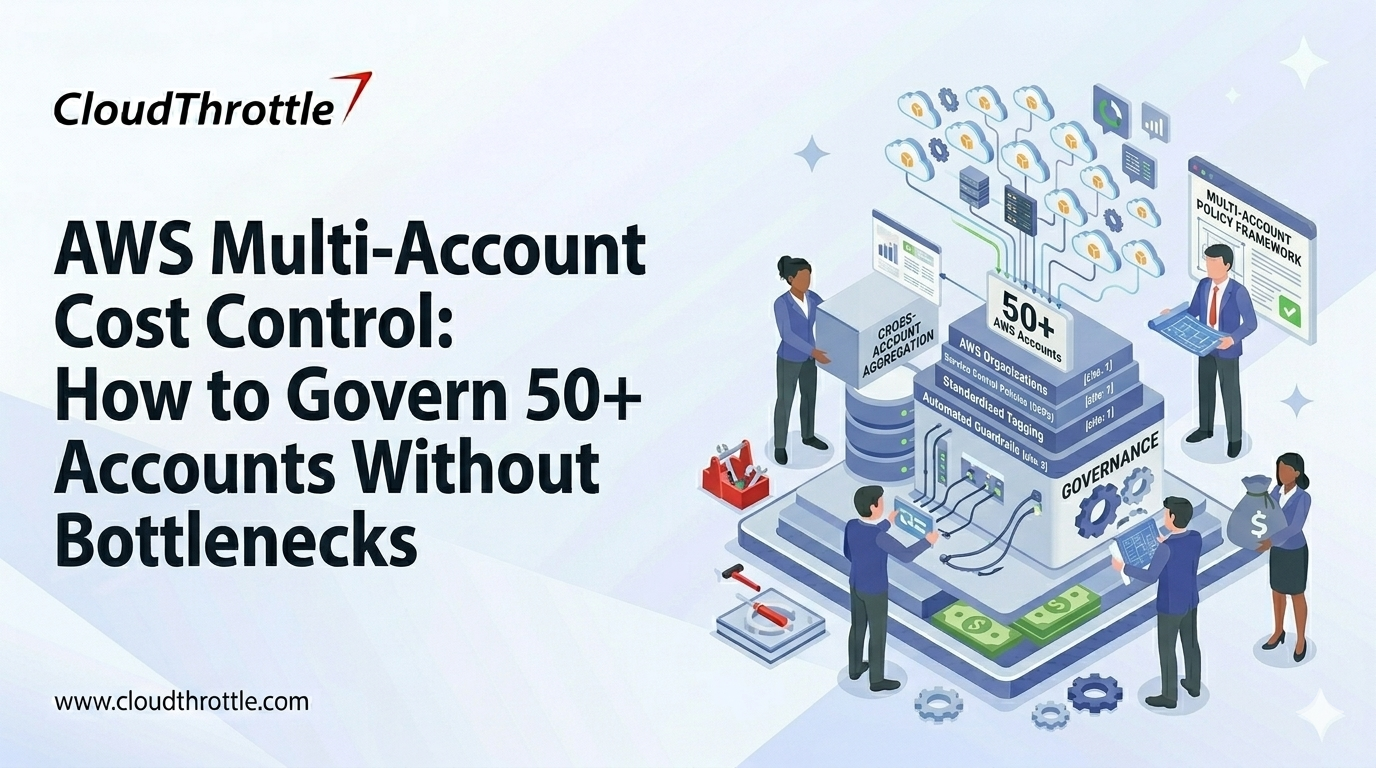
- AWS Organizations: AWS Organizations provides the structural foundation for AWS multi-account management. It helps companies group accounts under one hierarchy, apply organization-wide controls, and maintain a cleaner governance model as the account footprint expands.
- Consolidated Billing: AWS multi-account billing becomes easier to manage when charges roll into a centralized billing structure. Finance gains a broader view of total spend, and leadership can compare account behavior without losing account-level separation.
- AWS Cost Explorer: AWS Cost Explorer helps teams analyze spending patterns across services, accounts, and time periods. That insight supports stronger decision-making because teams can see where spend is stable and where it is drifting away from plan.
- AWS Budgets: AWS Budgets introduces control thresholds at different layers of the environment. Teams can define expected limits and connect those limits to alerts and limited automated actions (primarily notifications and IAM-based responses).
- IAM and Service Control Policies: IAM policies and service control policies give the governance model enforcement power, though they operate at permission and access levels rather than direct cost controls. Cost control becomes much stronger when the system can limit risky actions instead of only reporting them.
- Automation Tools Such as Lambda: Automation tools carry policy into execution, often required to bridge gaps where native AWS cost controls are limited. They reduce manual workload and support faster response when cost thresholds are crossed.
How the System Works?
The system begins with account-level usage and billing data. That data rolls into a centralized billing structure, which creates an organization-wide view of AWS spend. Cost Explorer and related reporting tools then help teams identify trends, anomalies, and recurring cost drivers. AWS Budgets adds threshold-based control, which places financial boundaries around accounts, workloads, or business units. IAM policies, service control policies, and automation then translate those thresholds into operational response.
That sequence matters because it turns cost management into a continuous process. Teams do not need to wait for month-end reviews to understand what is happening. Leaders gain visibility into spend direction. Account owners gain earlier warning. Cloud operations teams gain a system that supports governance without becoming a constant approval bottleneck.
Step-by-Step Strategy to Govern 50+ AWS Accounts
Below is a step-by-step strategy to govern 50+ AWS accounts effectively:
Step 1: Establish a Clear Account Structure
A clear account structure is the starting point for strong AWS multi-account cost control. Accounts should reflect the way the business actually operates. Some organizations group accounts by business unit. Others separate by environment, product line, or geography. The exact structure may differ, yet the logic must stay consistent across the organization.
A well-planned structure improves reporting and reduces ambiguity. Cost issues become easier to trace because the account itself already carries meaning. Leadership can review trends more confidently, and cloud teams can apply policies in a way that matches real ownership boundaries.
Step 2: Enable Consolidated Billing
Consolidated billing gives leadership one financial view across the AWS estate. That visibility is essential in large environments because the organization needs to understand both total spend and account-level contribution. A single bill also supports better financial oversight because discount usage and shared billing patterns become easier to interpret.
Account independence still matters, and consolidated billing does not remove that advantage. Teams can continue working within their own accounts, yet the organization gains a stronger basis for AWS multi-account billing analysis. This balance supports autonomy and governance at the same time.
Step 3: Implement Standardized Tagging Policies
Standardized tagging policies bring consistency to cost allocation. Tags should reflect business logic that all teams understand and use. Common fields often include team, environment, product, or cost center. Clear standards improve reporting because cost data can be grouped in a meaningful way across separate accounts.
Policy is only one part of the answer. Enforcement also matters. Teams need guidance on required tags, and governance teams need a method to review adoption. Cost data becomes much more reliable when tagging rules are consistent across the environment.
Step 4: Define Budget Policies at Multiple Levels
Budgeting works better when it exists at more than one level. An organization-wide budget helps leadership track total cloud spend. Account-level budgets help teams control their own financial boundaries. Workload-level budgets add further precision where large accounts support several projects.
This layered approach strengthens AWS cost governance because it avoids overreliance on one broad financial control. A top-level budget may show that spend is rising. A lower-level budget shows where the change is happening. Teams can then respond more precisely and with less confusion.
Step 5: Automate Cost Control Actions
Automation removes delay from the control model. A policy-backed response can trigger automated remediation (such as stopping resources, restricting actions, or notifying owners) as soon as thresholds are crossed. That matters in large account estates because cloud teams cannot manually review every budget event across dozens of accounts.
Automated response should be matched to workload sensitivity. Lower-risk environments can tolerate tighter restrictions. Business-critical environments often require more controlled action. Strong AWS cost control strategies recognize that difference and apply automation in a way that supports both discipline and operational stability.
Step 6: Monitor and Refine Continuously
Cost governance needs regular refinement because cloud usage patterns change over time. New applications appear. Teams scale services up or down. Resource behavior shifts as products mature. A budget or policy that worked well six months ago may no longer fit the environment today.
Regular review keeps the governance model aligned with real usage. Leaders can compare thresholds against actual spend patterns. Teams can identify weak spots in tagging, ownership, or automation logic. Continuous refinement keeps AWS multi-account cost control relevant as the environment expands.
Best Practices for AWS Multi-Account Cost Control Without Bottlenecks
Here are the best practices for managing AWS multi-account cost control without creating bottlenecks:
- Design Accounts Around Business Structure: Account hierarchy should reflect real ownership, such as business units, products, or environments. A clear structure improves reporting accuracy and simplifies governance decisions.
- Enforce Mandatory Tagging Standards: Every resource should follow a consistent tagging policy across all accounts. Standard tags create reliable cost allocation and make budget tracking more precise.
- Implement Layered Budget Controls: Budgets should operate at organization, account, and workload levels. This approach provides both high-level oversight and detailed control where needed.
- Automate Policy-Based Cost Controls: Automated rules should handle repetitive cost actions. This reduces manual effort and maintains consistent enforcement across all accounts.
- Provide Real-Time Cost Visibility to Teams: Teams should have direct access to their cost data. Better visibility improves accountability and supports faster decision-making.
- Align Cost Governance with Engineering Workflows: Cost considerations should be part of deployment and infrastructure decisions. This reduces the chance of cost issues appearing after resources are already in use.
- Review and Adjust Governance Regularly: Cost patterns change as workloads evolve. Regular reviews help keep budgets, policies, and thresholds aligned with current usage.
- Balance Control with Team Autonomy: Governance should guide teams without slowing them down. A balanced model allows innovation while maintaining strong financial discipline.
Conclusion
AWS multi-account cost control is far more than a billing exercise. It is a governance system that gives organizations a way to manage cloud growth without losing financial discipline. Centralized visibility gives leaders the full picture. Decentralized ownership gives teams a clear role in cost control. Automated enforcement gives the system speed and consistency.
Large AWS estates need that structure because manual review and fragmented reporting do not scale well across 50 or more accounts. A clear account hierarchy, reliable tagging standards, layered budget policies, and automation-backed controls create a model that supports growth without creating governance bottlenecks. That is the foundation of effective AWS cost governance in multi-account environments.
Managing 50+ AWS accounts requires more than dashboards and alerts. You need automated, policy-driven governance that works consistently across your entire cloud environment. Explore how CloudThrottle can help you implement centralized, automated budget governance across multiple AWS accounts and maintain full visibility without operational bottlenecks.
Note: Information reflects publicly available sources at the time of publication and may change.