For more than a decade, FinOps has helped organizations understand, manage, and optimize cloud spending. Teams learned to monitor compute hours, storage consumption, network costs, and application workloads togain visibility into their cloud investments.
Today, Artificial Intelligence is introducing an entirely new consumption model.
At FinOps X 2026, one topic consistently appeared across keynotes, breakout sessions, and industry discussions: Tokenomics.
As organizations adopt Generative AI, AI Agents,Retrieval-Augmented Generation (RAG), and Large Language Models (LLMs), traditional cloud metrics alone are insufficient. A new unit of consumption has emerged.
That unit is the token.
Just as cloud resources are the foundation of cloud costmanagement, tokens are becoming the foundation of AI cost management.
More importantly, they may serve as the foundation formeasuring AI value.
What Is a Token?
A token is the smallest unit of information that an AI model processes.
When you interact with ChatGPT, Claude, Gemini, or another Large Language Model, your prompt is split into smaller units called tokens before the model processes it.
A token is not always a complete word. Depending on the language and content, a token may represen
- A word
- Part of a word
- A punctuation mark
- A number
- A symbol
For example, the phrase: "Explain FinOps in simple terms".
may be split into several tokens before the model processesit.
Because AI models process tokens rather than entire sentences, token consumption is the primary metric AI providers use to measure usage.
How Token Consumption Works
To understand Tokenomics, consider a simple example.
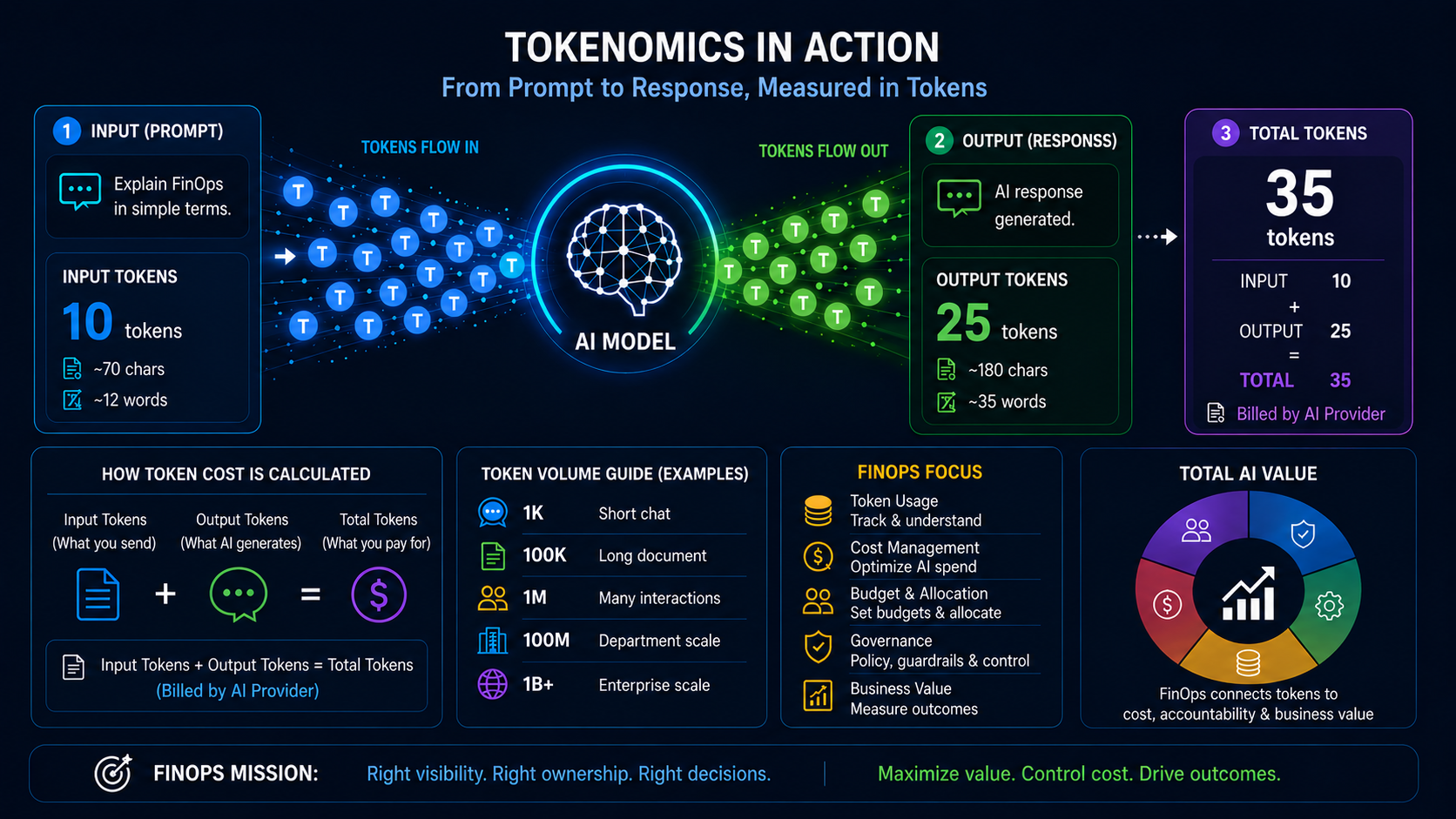
Suppose a user submits the prompt: "Explain FinOps in simple terms."
The prompt may consume approximately:
The AI then generates a response. The response may consume approximately:
Total token consumption:
In this simplified example: Input Tokens + Output Tokens = Total Tokens
Many AI providers charge based on the number of tokens processed. As token consumption increases, AI costs increase as well.
This direct relationship between consumption and spending isone reason tokens are often described as the "currency" of AI.
While this example shows output tokens exceeding input tokens, the relationship differs substantially by workload. Chatbots often generate more output tokens than they receive, while document analysis, research assistants, Retrieval-Augmented Generation (RAG) applications, and AI agents may consume far more input tokens than output tokens. Understanding these token consumption patterns is becoming an important part of AI FinOps and Tokenomics.
Why Larger Requests Cost More
Token consumption increases as prompts become larger and more complex.
For example, asking: What is FinOps?
may consume only a few dozen tokens. However, asking an AI model to analyze a 100-page documentcan require significantly more processing.
Consider the following example:
The larger the document, prompt, and response, the more tokens are consumed.
This is why applications such as:
- Contract Analysis
- Patent Reviews
- Research Assistants
- Knowledge Base Search
- AI Agents
can consume significantly more tokens than a simple chatbot conversation.
How Much Does One Million Tokens Cost?
One of the most common questions organizations ask when exploring AI is: "How much does one million tokens cost?"
The answer depends on a number of factors, including:
- The AI provider
- The model being used
- Input versus output token pricing
- Whether the workload includes embeddings or other AI services
Pricing varies across providers and changes over time, but understanding the scale of token usage is often more important than memorizing specific prices.
To put token consumption into perspective:
Many organizations are surprised by how quickly token consumption can grow.
For example, an AI assistant used by hundreds of employees throughout the day can easily process millions of tokens per month. AI-powered document analysis systems, research assistants, customer support bots, and AIagents may consume significantly more.
This is one reason FinOps practitioners are beginning to treat tokens the same way they once treated cloud resources. What starts as a small experiment can quickly grow into a substantial operational expense if consumption is not understood and monitored.
As AI adoption increases, understanding token volume becomes just as important as understanding token pricing.
Why FinOps Professionals Are Paying Attention
Cloud computing introduced a consumption-based pricing modelin which organizations pay for the resources they use.
Artificial Intelligence introduces a similar model, but with a different unit of measurement.
Instead of paying primarily for:
- Virtual Machines
- Databases
- Storage
- Containers
Organizations gradually pay for:
- Prompts
- Responses
- Context Windows
- AI Agent Interactions
- Embeddings
- Retrieval Operations
All of these activities ultimately consume tokens.
As AI adoption accelerates, token consumption is becoming asignificant driver of technology spending.
Many organizations are discovering that AI usage can grow much faster than traditional cloud workloads because each interaction consumes additional tokens.
Understanding Context Windows
Another important concept in Tokenomics is the context window. A context window represents the amount of information an AI model can consider when generating a response.
Examples include:
- Previous conversations
- Uploaded documents
- Internal knowledge bases
- Policies and procedures
- Application data
Larger context windows often improve response quality because the model has more information available.
However, larger context windows may also increase token consumption, there by increasing costs.
This creates a balance between performance, accuracy, and cost efficiency.
Is the Token Bill the Entire AI Cost?
For many organizations using services such as ChatGPT Enterprise, Claude, or Gemini, AI costs are often closely tied to token consumption.
In these scenarios, the provider manages:
- GPU Infrastructure
- Model Hosting
- Platform Operations
- Scaling
- Availability
As a result, organizations primarily focus on token-based usage charges.
However, enterprises building custom AI solutions commonly incur costs beyond token costs.
Examples may include:
- Vector Databases
- Embedding Generation
- Cloud Infrastructure
- Retrieval Systems
- Monitoring Platforms
- Security Controls
This means that while tokens are the primary unit of AI consumption, they do not always cover the full cost of delivering an AI solution.
Recognizing this distinction is one reason the FinOps community has expanded the discussion from simple token counting toward broader AI economics.
The Shift from Cloud FinOps to AI FinOps
Traditional FinOps focused on cloud resources.
This evolution does not replace traditional FinOps.
Instead, it expands FinOps into a new domain where organizations must manage both cloud infrastructure and AI consumption.
The challenge is no longer simply understanding infrastructure costs.
The challenge is understanding how AI consumption translates into business outcomes.
Beyond Cost Per Token
Many organizations initially focus on questions such as:
- How can we reduce token consumption?
- Which AI model costs less?
- How can prompts be optimized?
These are important questions.
However, FinOps X introduced a broader perspective.
The goal is not simply to minimize token costs. The goal is to maximize business value.
Both applications consume identical resources. Yet one creates significantly more business value. This introduces a new way of thinking about AI investments.
Organizations must begin evaluating not only cost per token but also value generated per token.
The Emergence of Tokenomics
Tokenomics is the discipline of understanding how tokens are consumed, measured, and connected to business outcomes.
The concept goes beyond simple cost management.
It includes:
- Token Consumption
- Cost Attribution
- Resource Allocation
- Accountability
- Governance
- Business Value Measurement
This represents the next evolution of FinOps asorganizations seek to bring financial accountability to AI initiatives.
What Comes Next?
As organizations mature their AI strategies, token visibility will become only the first step.
The next challenge will be governance.
Questions such as these are already emerging:
- Should teams receive AI budgets?
- How should AI costs be allocated?
- What happens when AI spending exceeds expectations?
- How can organizations forecast future AI consumption?
- Who owns AI spending accountability?
These questions are beginning to define the future of AI FinOps.
In our next article, we will explore why token visibility alone is not enough and how organizations are beginning to think about AI budget governance, accountability, and financial controls.
Final Thoughts
Tokenomics is quickly becoming one of the most important concepts in modern FinOps.
As AI adoption accelerates across every industry, tokens are emerging as the new unit of technology consumption. Understanding how tokens are consumed, measured, and connected to business outcomes will become increasingly important for technology leaders, FinOps practitioners, and business stakeholders as well.
The organizations that develop visibility into AI consumption today will be more prepared to establish governance, accountability, and value measurement tomorrow.
And as FinOps continues to evolve, Tokenomics may become the bridge connecting AI innovation and financial responsibility.
Related Articles
- Why Token Visibility Is Not Enough: The Rise of AI Budget Governance (Coming Soon)
- AI Budget Management: Applying FinOps Principles to Generative AI (Coming Soon)
- Smart Budgeting for AI Consumption: The Next Evolution of FinOps (Coming Soon)